

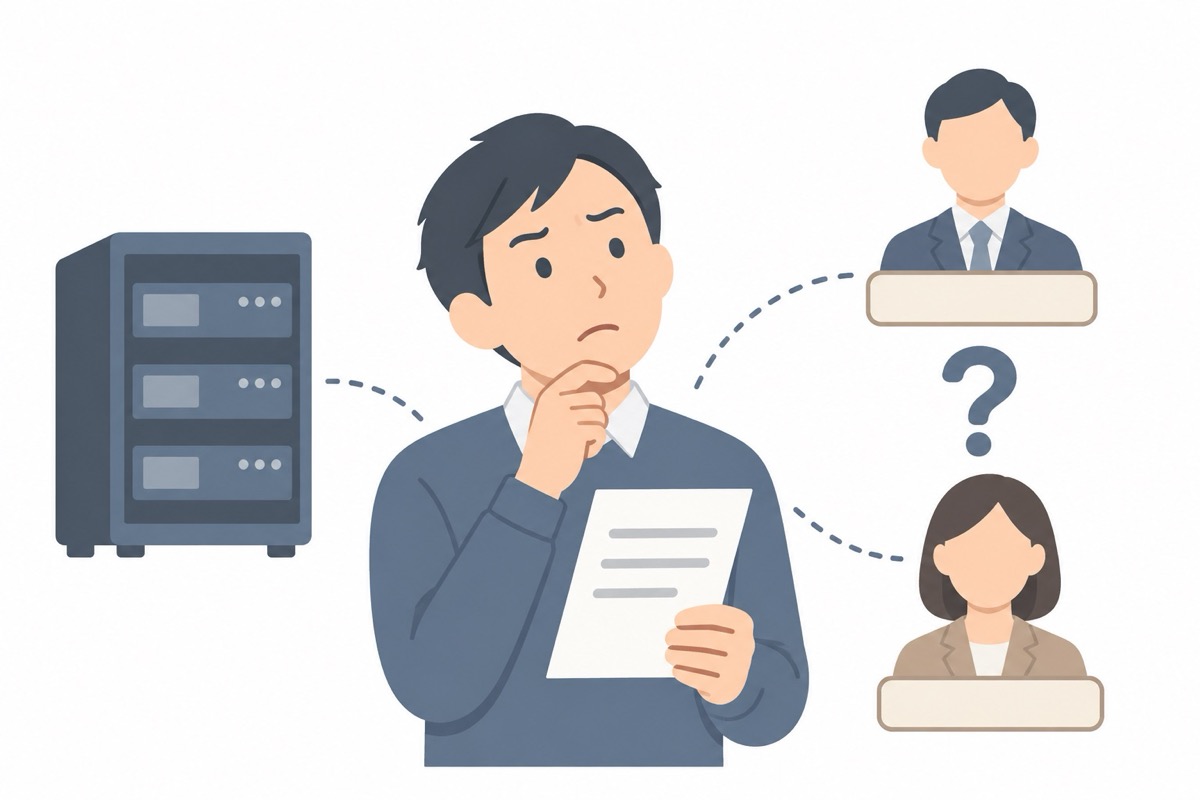
- In IPA’s “10 Major Security Threats 2026” for organizations, attacks on supply chains and contractors rank 2nd, and attacks exploiting system vulnerabilities rank 4th. Missing patches on public servers sit at the overlap of the two.
- A public server is made of seven layers: hardware or hosting, OS, middleware, CMS and plugins, application, domain and certificate, and backups. Different people touch each layer.
- A web agency’s maintenance contract usually covers only the CMS and application layers. If OS, PHP or database updates are not written anywhere, nobody is looking at those layers.
- The fix is a one-page responsibility matrix that says who does what, when, and how it is confirmed, for each of the seven layers. The blank rows are your biggest gap today.
- Even in the cloud, patches above the OS are the customer’s job. The “shared responsibility model” published by AWS and others shows where your part begins.
Why “we have a maintenance contract” is not an answer
In “10 Major Security Threats 2026”, published every year by IPA (Information-technology Promotion Agency, Japan), “attacks on supply chains and contractors” rank 2nd for organizations and “attacks exploiting system vulnerabilities” rank 4th. A public server with missing patches (software fixes) is exactly where these two meet.
JPCERT/CC (Japan’s security coordination center) publishes alerts; in October 2026 alone it issued alerts about multiple vulnerabilities in PHP, among others. When such an alert appears, few companies can answer immediately “does this affect our server?” and “who will apply the fix?”.
Even companies that answer “we have a maintenance contract” often find, when they read it, that the scope ends at “page changes, CMS updates and contact in case of failure”, with no mention of OS or middleware updates. From the agency’s point of view, “the server is the customer’s hosting or cloud account, so it is not our scope”. Nobody is acting in bad faith; the layer in between is simply empty.
A public server has seven layers
The fastest way to find the empty layer is to split the server into layers.
| Layer | Examples | Who touches it (typical situation) |
|---|---|---|
| Server itself | Shared hosting, cloud virtual server, physical server in the office | Hosting company or cloud provider (the account is in your name) |
| OS | Linux, Windows Server | Often nobody |
| Middleware | PHP, Apache, nginx, MySQL/PostgreSQL, the container base | Often nobody |
| CMS and plugins | WordPress core, plugins, themes | Usually covered by the agency’s maintenance contract |
| Application | Contact form, member area, custom development | Web agency |
| Domain and certificate | Domain renewal, TLS certificate (the key behind https) renewal | Often only admin staff receiving renewal emails |
| Backups | Frequency, storage location, restore procedure | Often stops at “the hosting company must be doing it” |
In assessments, the empty rows are most often OS and middleware. The agency covers the CMS and above, the hosting company covers the server itself, and in between an unsupported PHP or an old database stays unchanged for years. As we wrote in EOL risks and countermeasures, software that has reached end of support no longer receives fixes at all.
Build a one-page responsibility matrix
The task is to write one table with “who, when and how to confirm” for each of the seven layers. It is a simplified RACI (a project-management idea that separates who does the work, who is accountable, who is consulted and who is informed). Here it is enough to name two people: the one who does the work and the one inside your company who confirms it.
| Layer | Who does it (can be external) | Who confirms internally | When | How to confirm |
|---|---|---|---|---|
| Server itself | Hosting company | Admin staff | At contract renewal | Read the scope in the contract |
| OS | (blank = today’s gap) | Admin staff | Monthly | Receive an update report |
| Middleware | (blank = today’s gap) | Admin staff | Monthly | Receive a version list |
| CMS and plugins | Web agency | PR / admin staff | Monthly | Receive the update history |
| Application | Web agency | PR / admin staff | On issues and once a year | Receive the change record |
| Domain and certificate | Agency or admin staff | Admin staff | One month before expiry | Write the expiry date in a register |
| Backups | Hosting company or agency | Admin staff | Monthly and once a year | Backup records, plus a yearly restore test |
The rows where the “who does it” column stays blank are your biggest gap today. There are three ways to fill them: add them to the agency’s maintenance contract, move to a “managed” hosting plan that includes operations, or hire a separate server maintenance company. The person who confirms needs no IT knowledge; someone who checks once a month whether the report arrived is enough.
Wording to check in the contract
IPA’s “Information Security Guidelines for SMEs” (version 4.0) lists, among the actions for management, making responsibilities clear when outsourcing or using external services.
Re-read your current maintenance contract for these points.
- The “scope” of maintenance names the OS and middleware, not only the CMS and application
- “Applying security updates” is written as a task (“responding to defects” alone means nothing happens unless you ask)
- There is a deadline for contact and response when a serious vulnerability is published
- A monthly report (updates applied, current versions) is written in
- Backup frequency, storage location and restore tests are written in
- Handover of admin passwords and settings at the end of the contract is written in
If something is missing, ask for a quote to add it. If you are unsure how to word it, the “Model Transaction and Contract for Information Systems”, first published by Japan’s Ministry of Economy, Trade and Industry in 2007 and updated by IPA as a second edition, includes a template for maintenance and operation contracts. It is not meant to be used as is, but it shows how a “scope of maintenance” can be written.
In the cloud, read the “shared responsibility model”
“Our server is in the cloud, so the cloud provider must be patching it” is another sentence we hear often. It is only half right. The AWS shared responsibility model page says:
In other words, if you rent a virtual server (EC2 on AWS), everything from the OS upward is your side. The same page explains that for services such as S3 the provider operates the OS too, so your share changes with the service you choose. The basic pattern is to write the cloud provider’s name in the “server itself” row of your matrix, and your side (in practice, your contractor) in the “OS” and “middleware” rows.
What to do, in order
- This week: list every public server (website, forms, booking system and so on) and build the seven-layer table for each. Mark the layers where “who does it” is blank
- This month: re-read the maintenance and hosting contracts against the six points above. Ask the agency and the hosting company in writing whose scope OS and middleware updates are
- Next month: decide how to fill the blank layers and get quotes. At the same time, check the versions visible from outside with a free assessment and deal first with anything out of support
- Every month: the internal confirmer checks that each layer’s report (updates applied, current versions) has arrived, and chases it if not
- Once a year: review the matrix and fix the contract wording at renewal. Test that backups can actually be restored
Not sure what your own environment runs on?
With our Security & IT Support, you can hand over everything from inventorying the technologies and versions you use to checking them against vulnerability information, applying fixes and verifying after updates. It is a monthly subscription (quasi-mandate contract) of 5–15 hours a month from US$200/month, with Japanese-language support and only a 2-hour time difference from Japan.