

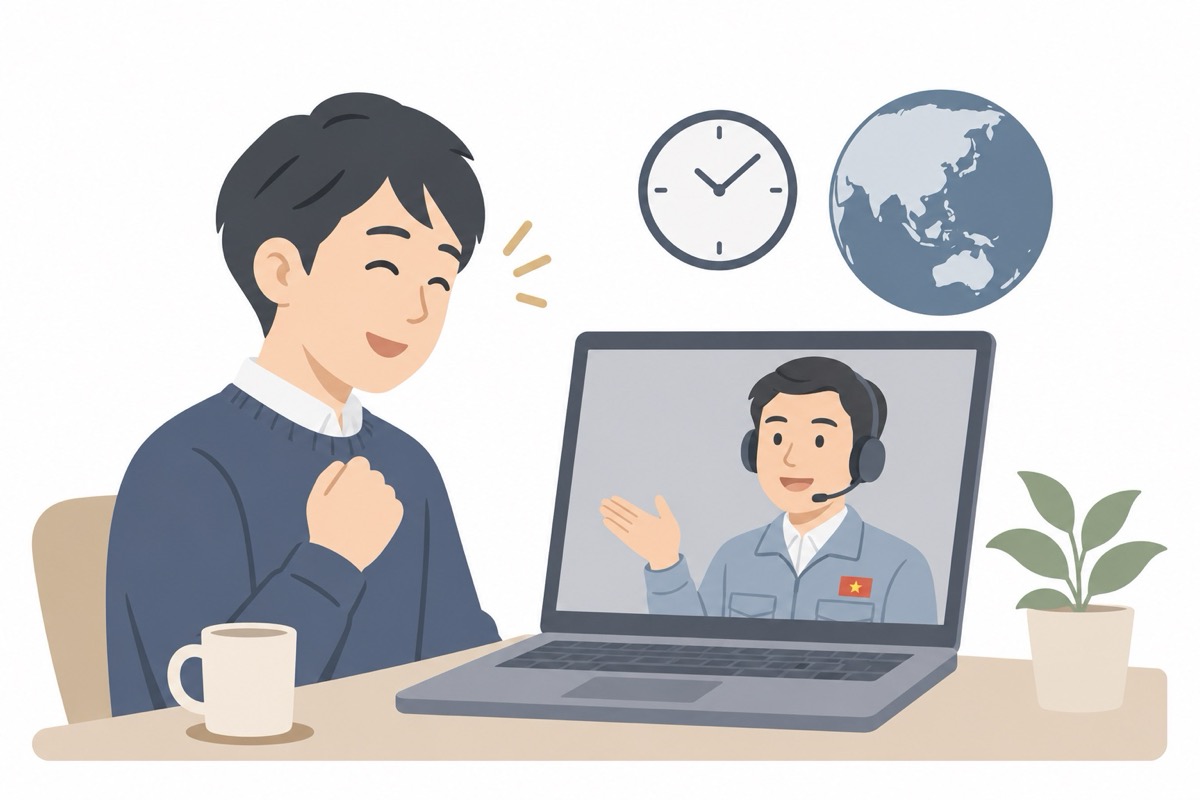
- One estimate puts Japan’s IT talent shortage in 2030 at up to 787,000 (high-demand scenario), making it harder to staff IT purely in-house.
- Vietnam is only 2 hours behind Japan. Japan’s 9:00–18:00 is 7:00–16:00 in Vietnam.
- Vietnam has 164,495 Japanese learners (6th in the world), and among inquiries to Offshore Kaihatsu.com, Vietnam is the top destination at 43%.
- On the other hand, it doesn’t suit on-site work or cost-only motives. Checking how data is handled and how the team is organised comes first.
Why companies consider outsourcing IT support: Japan’s IT talent shortage
Managing PCs and accounts, updating servers, responding to vulnerabilities — many companies get by with someone in general affairs handling all this on the side. And even if you try to hire, IT talent itself is in short supply.
The “Survey on IT Talent Supply and Demand” (March 2019), commissioned by Japan’s Ministry of Economy, Trade and Industry, estimates the 2030 shortage at up to 787,000 in the high-demand scenario, 449,000 in the mid scenario and 164,000 in the low scenario (all assuming 0.7% productivity growth). Every scenario shows a shortage (report).
If hiring is hard, the next option is outside help — either a domestic provider or an overseas one, especially in Vietnam. We compare the three options in Three options for SMBs without an IT person.
Five reasons Vietnam is chosen as an outsourcing destination
Reason 1: A 2-hour time difference covers almost all of Japan’s business hours
Vietnam is UTC+7 and Japan UTC+9, so Vietnam is 2 hours behind Japan. There is no daylight saving time and one time zone nationwide (Arukikata). 9:00 in Japan is 7:00 in Vietnam, so Japan’s business day is covered the same day. “A request sent in the morning comes back the same day” is something countries with large time differences can’t offer.
| Japan time | Vietnam time | Typical use |
|---|---|---|
| 9:00 | 7:00 | Receive requests at the start of Japan’s workday |
| 12:00 | 10:00 | Answer and work on morning requests |
| 18:00 | 16:00 | Report the day’s work before Japan closes |
Reason 2: Many people study Japanese
According to the Japan Foundation, Vietnam has 164,495 Japanese learners (FY2024; 490 institutions, 4,230 teachers), 6th in the world. That is slightly down from 169,582 in FY2021 but still large. The same report notes that universities are adding Japanese courses to science and engineering faculties to train Japanese-speaking professionals, and that Japanese companies often use N3–N2 as a hiring benchmark (Japan Foundation country report).
JLPT test-takers in Vietnam numbered 27,934 in July 2024 and 29,089 in December 2024 — about 57,000 across the two 2024 sessions. In July 2025, 30,175 sat the test (Jul 2024, Dec 2024, Jul 2025).
Reason 3: A track record as Japan’s offshore destination
According to the Offshore Development White Paper 2025, among inquiries to Offshore Kaihatsu.com the most common destination is Vietnam (43%), well ahead of China (21%) and India (14%). Note that this is based on inquiries the site received from January to December 2025, not on Japan’s overall offshore spend (white paper page).
The white paper cites “a friendly attitude toward Japan, diligence, geographic proximity and relatively low rates” as reasons for choosing Vietnam. The Japan Foundation report also notes 2,543 Japanese companies doing business in Vietnam (as of October 2024), an environment where people gain experience working with Japanese firms.
Reason 4: A growing IT workforce
According to press reports citing the Ministry of Information and Communications, Vietnam had about 1.26 million ICT workers as of November 2024 (Báo Đầu tư). We have not checked the ministry’s original, so treat it as a rough guide. More important than headcount is checking what skills a provider has, how many people, and how the team is organised.
Reason 5: Personal data protection laws are maturing
According to a law firm’s analysis, Vietnam’s first comprehensive Personal Data Protection Law (PDPL, 91/2025/QH15) took effect on January 1, 2026. It sets out data processing impact assessments (DPIA), transfer impact assessments (TIA) and fines of up to 5% of the previous year’s revenue for cross-border transfer violations, and the grace period for small businesses reportedly does not apply to companies that process personal data on behalf of others (Tilleke & Gibbins). Clear obligations on providers are something to check — and also a source of reassurance.
To be honest: when outsourcing to Vietnam doesn’t fit
Outsourcing to Vietnam isn’t a cure-all. In the following cases, a domestic provider or an in-house person may be a better fit.
- Lots of on-site work: office cabling, installing printers or physically repairing PCs need someone on site and can’t be done remotely.
- “As cheap as possible” is the only goal: the white paper itself notes that rising wages and the weak yen have narrowed the cost advantage. Choosing on rate alone often disappoints.
- No one in-house can coordinate requests: wherever the provider is, without one internal contact, priorities don’t get set and nothing moves.
- Rules forbid any data leaving the country: if contracts or industry rules prohibit even overseas access, confirm that condition first.
Common concerns and how to address them
Concerns about overseas outsourcing usually fall into one of the rows below. Each can be reduced by checking before signing and preventing problems by design.
| Concern | Countermeasure |
|---|---|
| Data leaks and unauthorised access | Check the scope of ISO/IEC 27001:2022 certification. Grant only the access needed and keep logs |
| Leaks through people | NDAs at both company and individual level; training at hiring and periodically |
| Cross-border transfer of personal data | Don’t store production personal data in Vietnam (remote access to Japanese cloud, work on masked data) |
| Language and communication | A Japanese-language desk, with work logs and reports in Japanese |
| A key person leaves with no handover | Runbooks, a multi-person team and regular handovers |
| Rising wages and a weak yen | Judge on total value including quality and team, not unit rate alone |
The 2025 white paper also names “communication” as the single most important factor for offshore success. We list concrete checks in the information security checklist for outsourcing IT overseas.
Five things to check when choosing a provider
- Does it hold ISO/IEC 27001 certification, and does the scope cover the work you want to outsource?
- Can you request and receive reports in Japanese — not just the desk, but reports and work logs too?
- Can it explain where personal data sits and who accesses it from where?
- Is the work spread across more than one person, with runbooks and handover?
- Can you start small (capped hours, clear termination terms)?
FAQ
Q. Will it cost half as much as in Japan?
A. There’s no simple answer. The white paper lists Vietnamese monthly rates (e.g. ¥401,000 for a programmer), but we haven’t found reliable Japanese figures measured the same way. The white paper itself says the cost advantage has narrowed. It’s safest to estimate based on the volume and type of work and compare total costs.
Q. How well is Japanese understood?
A. It varies by company and person. Japanese firms often use N3–N2 as a hiring benchmark, but the best test is a pre-contract meeting to see how far technical topics can be discussed in Japanese.
Q. Could Vietnamese law put our data at risk?
A. According to a law firm’s analysis, the new Cybersecurity Law (116/2025/QH15), reported to take effect on July 1, 2026, requires data localisation from telecom and internet service providers that collect and process personal data in Vietnam (Allen & Gledhill). Confirm with your provider whether your work is affected — but if you keep production data in a Japanese cloud and have the work done remotely, little data stays in Vietnam. Also check how Japan’s Act on the Protection of Personal Information applies.
Summary: how you outsource matters more than “why Vietnam”
Japan’s IT talent shortage persists in every scenario, from 164,000 to 787,000. With a 2-hour time difference, many Japanese learners and a track record with Japanese companies, Vietnam is a realistic choice for outsourcing security and IT support.
But it doesn’t fit if you need lots of on-site work or only want lower costs. Check the provider’s certification scope, where data lives and how the team is set up, then start small and expand. We at HAYTECH SOLUTIONS provide this kind of support from Ho Chi Minh City, in Japanese. Try starting with a small task such as finding unsupported software.
Use our Vietnam-based team through a Japanese-language desk
HAYTECH SOLUTIONS is based in Ho Chi Minh City and supports Japanese companies’ security and IT under an ISO/IEC 27001:2022-certified management system. The time difference with Japan is only 2 hours, and our desk works in Japanese. You can start small, from US$200/month.